Why Martingale And Grid Trading Bots Always Fail (And Why Everyone Sells Them Anyway)
Martingale and grid bots produce the prettiest backtests in the business. Here's the maths behind why they eventually take the account, and why the marketplace is full of them anyway.
There's a betting system that's four hundred years old.
Bet a pound on red. Lose it.
Bet two pounds on red. Lose that.
Bet four. Then eight. Then sixteen.
Eventually red comes up.
You win it all back plus your pound.
And you stroll out feeling like a genius.
It's called martingale.
It was named after a French casino owner.
Which should have been everyone's first clue.
Because here's the thing about a system invented in a casino.
The casino kept it.
They didn't ban it. Didn't discourage it.
They put a maximum bet on every table and let people crack on.
That's the entire counter-measure.
Because once there's a ceiling on how much you can double into, martingale stops being clever.
It becomes a slow way of handing over your wallet.
Four hundred years later, it runs most of the retail trading bots on the market.
Same maths. Nicer branding.
What Is Martingale Trading? And What Is Grid Trading?
Let's take the mystery out of both.
Martingale trading means a trade loses, so the next one is bigger.
Usually double. Keep doubling until one wins.
Grid trading means a ladder of orders at set intervals.
Price moves against you, more of them fill.
Your position grows the further wrong you are.
They're technically different.
In practice they fail identically.
Both share one feature that decides everything.
Your position gets bigger the more wrong you are.
That's the whole design.
Hold that sentence. Everything below comes from it.
Sellers will tell you their version is different.
It's got a "smart recovery module."
It's "adaptive." It uses "intelligent averaging."
There's a thesaurus for this and it all means one thing.
It's losing, so it's buying more.
Why Do Martingale EAs Have Such High Win Rates?
Here's why every developer in the marketplace builds these.
Not because they're stupid.
Because they're easy and they sell.
Run a martingale EA over ten years of data.
You get an equity curve like a bannister.
Straight. Smooth. Barely a wobble.
95% win rate. Sometimes 98%.
Sometimes the full hundred.
And every number on that report is technically true.
Here's why.
A martingale almost never books a loss.
It doesn't close the losing trade.
It holds it and adds until price comes back.
Then the whole basket closes green together.
So the win rate is 97%.
Not because it's right 97% of the time.
Because it refuses to admit when it's wrong.
The losses are all still there.
Floating. Unrealised.
Sitting in a drawdown column nobody puts on the sales page.
It's not a track record. It's an unpaid bill.
Which brings us to the trick that sells more EAs than anything else.
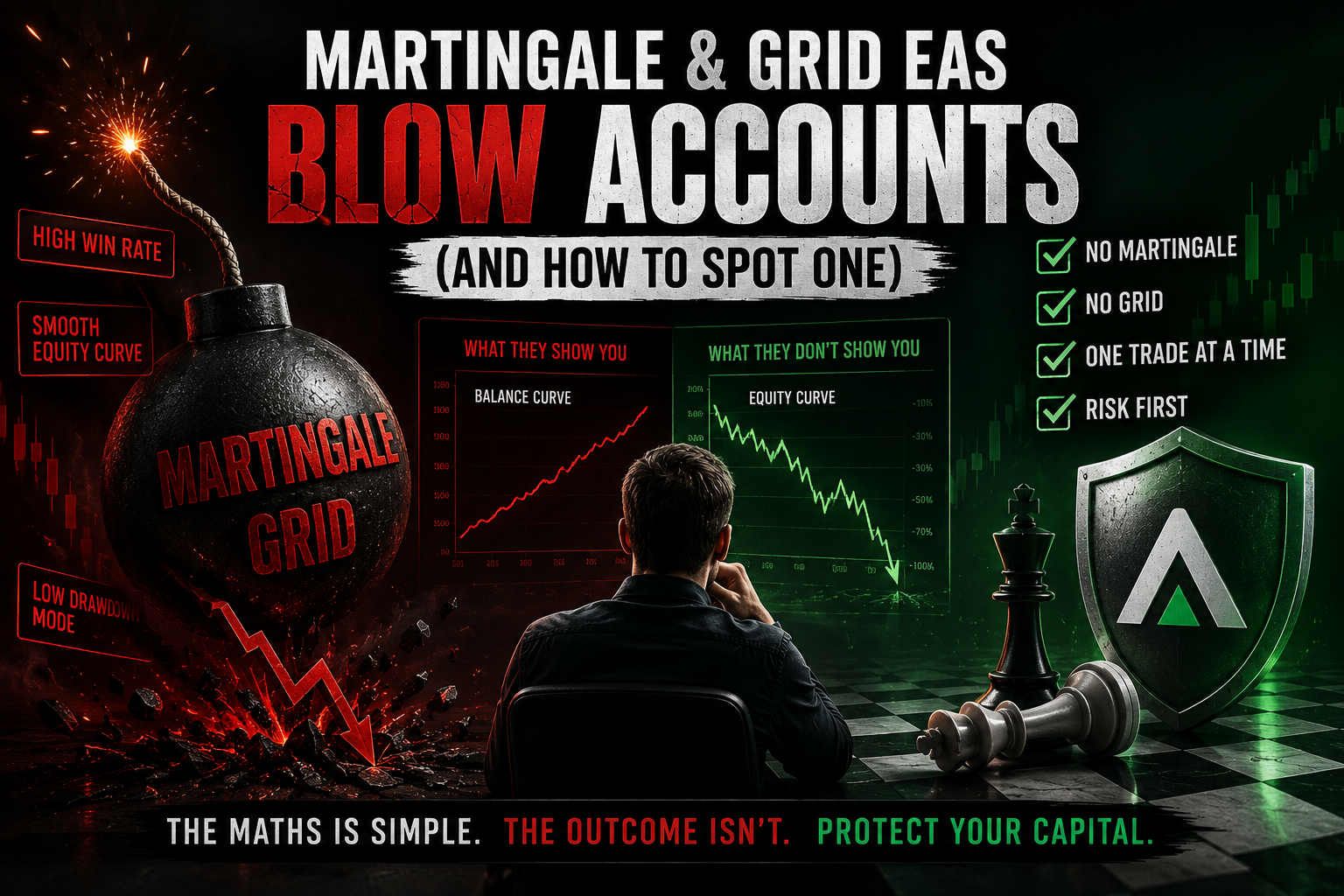
Show the balance curve. Never show the equity curve.
Balance is what you've closed. Lovely and smooth.
Equity is balance plus what's open.
Including the horror currently floating at minus forty percent.
Any seller showing one line has made a choice about which one.
Does Martingale Trading Actually Work?
Now let's be fair. This is the bit that traps people.
Martingale works.
Genuinely. For weeks. Often months.
You'll get a run where every week is green.
It'll feel like you've finally cracked it.
You'll start thinking about sizing up.
I know, because I built one.
Not twenty years ago either. Recently.
Hired a coder, built the exact thing I'd spent a career warning people about.
And watched it print for months.
I actually started wondering whether I'd had it wrong all along.
Then one Thursday the market did something ordinary and unhelpful.
And it did precisely what I'd built it to do.
Add. Add. Add.
That's the trap in one sentence.
It's not that they don't work.
They work well enough to change your mind.
You don't lose slowly with these.
You look brilliant, then you look ruined.
There's nothing in between.
Why Martingale EAs Blow Accounts: The Scaling Problem
This is the most important thing in this article.
Everyone assumes a bigger account is a safer account.
With martingale, that's dangerously wrong.
Here's the maths.
A martingale sequence doubles.
Say it starts at 0.01 lots.
Trade 1: 0.01 lots
Trade 2: 0.02
Trade 3: 0.04
Trade 4: 0.08
Trade 5: 0.16
Trade 6: 0.32
Trade 7: 0.64
Trade 8: 1.28
Trade 9: 2.56
Trade 10: 5.12
Ten losses in a row and you're putting on five lots.
Total exposure across that sequence is over ten lots.
From a starting size of 0.01.
That's the bit people never picture.
And ten losses in a row isn't rare.
A 50% system does that regularly.
Now here's the punchline.
That sequence has to start at roughly the same size regardless of your account.
Why?
Because the sequence is what it is.
Start a $50,000 account at five times the lot size of a $10,000 one and you hit ruin at the same step.
You've just scaled the bomb along with the account.
So the developer does the only thing available.
Keeps the starting size small and fixed.
Which means your $10,000 account and your $50,000 account trade the same lot sizes.
The bigger account isn't safer.
It's got a bigger cushion for the same explosion.
The drawdown percentage looks smaller on the way down.
Which feels reassuring, right up until step eleven.
You're not earning more on more capital.
You're earning the same money on more capital.
With the same eventual outcome.
A strategy that can't size with the account isn't a strategy.
It's a fixed-payout machine with a fuse on it.
That's why nobody runs martingale at institutional scale.
Not because they haven't heard of it.
Because it doesn't scale, and everyone doing this for a living worked that out long ago.
Why Are There So Many Grid And Martingale EAs For Sale?
Follow the incentives. It's not a conspiracy. It's economics.
They're quick to build. A grid EA is a weekend's work.
A real system is years of testing and rejection.
They demo brilliantly. A backtest sells an EA.
Nobody buys the one with a 55% win rate and visible losing streaks.
Even though that's the one that survives.
The seller's risk is zero. They were paid on day one.
Your blow-up happens in month seven.
By then the listing has a new name.
And the failure looks like your fault.
"You used the wrong pair."
"Your risk setting was too high."
"You should have turned it off before the news."
The maths never gets blamed, because the maths only shows up once.
None of that needs a villain.
It just needs a market where the pretty backtest gets the sale.
How To Tell If An EA Uses Martingale
Thirty seconds. Works on anything, including mine.
Look at the lot sizes in the trade history.
If they increase after losses, you're done.
That's your answer, whatever the sales page called it.
Count concurrent positions.
One or two open is a system.
Nine open on the same pair in the same direction is a man digging.
Ask for the equity curve, not the balance curve.
If they'll only show one, you already know which.
Find the maximum drawdown.
Not average.
Maximum.
If it's not published, that's your answer too.
And the best question, which almost nobody asks.
What does it do when it's wrong?
Not when it's right.
Anything looks clever when it's right.
What Real Automated Trading Risk Management Looks Like
I'm not going to pretend this bit isn't a pitch. It is.
But it's the honest version.
ARCIS Trade came out of that blown account, and twenty years of doing this before it.
Three rules. Not negotiable on any system on the platform.
No martingale, no grid.
Nothing ever adds to a losing position.
Not once. Not as a "recovery mode."
Not under any condition.
One trade at a time. Each position stands or falls alone.
No baskets, no ladders, no hoping.
Risk first. The stop is placed before the trade, off market structure.
Below the swing low on a buy, above the swing high on a sell.
Not an arbitrary pip count.
And never moved because the trade got uncomfortable.
Here's what that costs us, honestly.
The equity curve isn't a straight line.
It has dips, because losses get taken when they happen rather than parked.
One system wins about half its trades.
Half.
It still finishes ahead, because the winners are bigger than the losers.
Which is the only way any of this ever works.
Another went live and lost both its first two trades.
It's still on the results page.
That's a worse marketing asset and a better trading system.
We'd rather have the second one.
Every trade is visible, open to close.
Winners and losers together.
The systems still in forward testing sit alongside the live ones.
Because if you can only see the good weeks, you can't judge anything.
And that's exactly how people end up owning a martingale EA without knowing it.
Watch it run for 14 days. Free, no card, nothing to install.
Every trade visible — including the ones that lose.
[Start your 14 days ]
P.S. If you're running something right now, go and check the lot sizes tonight. Five minutes. If they double after a loss, you don't have a losing system yet. You have a winning one with a countdown attached, and you don't know what number it's on.
Common questions
Does martingale trading ever work?
It works consistently until it doesn't. Regular small gains, then one catastrophic loss. The sequence needs infinite capital to guarantee recovery, so the loss always arrives eventually.
What is the difference between martingale and grid trading?
Martingale increases position size after each loss. Grid places orders at intervals so exposure grows as price moves against you. Both increase your position the more wrong you are.
How can I tell if an EA uses martingale?
Check the lot sizes in the trade history. If they increase after losing trades, it's a martingale regardless of what the seller calls it.
Why do martingale EAs have such high win rates?
Because they rarely close a losing trade. They hold and add until price recovers, so almost every closed trade shows a profit. The losses sit in unrealised drawdown.
Can martingale work on a bigger account?
No. The starting lot size stays fixed regardless of account size, so a larger account earns the same money with the same ruin point.