Why Most Traders Switch Off Profitable Systems (The Calendar Problem)
One month had more losing days than winning ones and still finished up. The next was green almost every day. Same systems, same rules. Here's what that tells you about judging a system by the calendar.
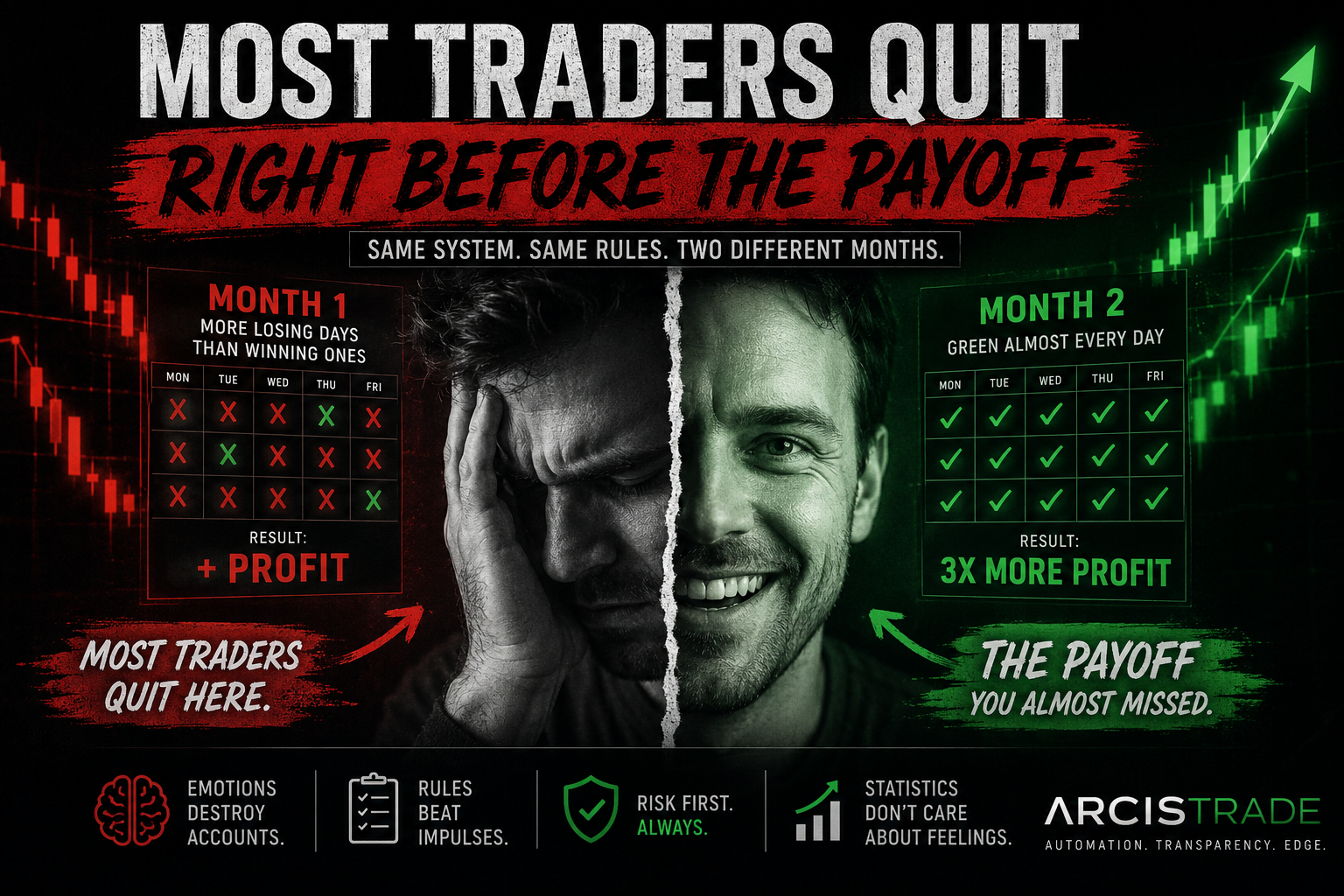
Nothing changed between them at all.
The first had more losing days than winning ones. It finished the month in profit.
The second was green almost every day and made three times as much.
Most traders would have switched the systems off somewhere in the middle of the first month.
Which means they wouldn't have been there for the second.
That's not a hypothetical. It's the single most common way people destroy a perfectly good strategy — and it has almost nothing to do with the strategy itself.
Why a losing month can still be a winning month
Here's the thing most people never sit down and work out.
The number of green days tells you almost nothing.
What matters is the size of the green days against the size of the red ones.
A month can run eleven losing days against ten winning ones and finish comfortably up, provided a handful of those winners are several times larger than an ordinary loser.
That happens constantly in real trading.
It's not an anomaly, it's the mechanism.
Trend-following systems in particular spend long stretches taking small losses and then make the month back in a few sessions when a move finally runs.
If you judge that by the calendar, it looks broken for weeks at a time.
If you judge it by expectancy, it's doing exactly what it's supposed to do.
What a trading drawdown actually feels like day by day
Here's the bit nobody prepares you for.
A trading drawdown doesn't announce itself as a drawdown.
It arrives as an ordinary losing day. Then another one. Then a small green day that gives you hope.
Then two more red.
At no point does anything dramatic happen.
That's precisely what makes it dangerous.
By day four, the thought has arrived: something's wrong with this.
By day six, you're looking at the settings.
By day eight, you've either turned it off or changed something.
And here's the cruel part — you almost never find out whether you were right, because once you've interfered, the original system no longer exists to be measured.
The three mistakes traders make during a drawdown
1. Interfering with the settings. Tightening a stop, widening a target, filtering out the setups that lost recently.
Every one of these means you're now trading a strategy that was never tested.
You've optimised on the last ten trades, which is the smallest and least reliable sample available to you.
2. Turning it off. The most common one, and the most expensive.
Systems tend to be switched off after a bad run, which is statistically the point at which nothing about their future expectancy has changed.
You've paid the cost of the drawdown and then walked away before the recovery.
3. Adding risk somewhere else. Down on one system, so more size goes into another to make it back faster.
This is revenge trading with an extra step, and it's how a bad month becomes a bad year.
All three come from the same root cause: judging a long-horizon process on a short-horizon sample.
What a normal losing run actually looks like
Most people have never worked this out, and it's the single most useful number in trading.
A system winning half its trades will produce a run of nine or ten consecutive losses reasonably regularly over a few hundred trades.
That's ordinary probability, not failure.
Rough guide:
70% win rate — expect runs of 5 or 6 losses
60% win rate — expect runs of 7 or 8
50% win rate — expect runs of 9 or 10
40% win rate — expect runs of 12 to 14
Look at that 50% line and be honest with yourself.
Would you still be running a system on loss number seven?
Most people wouldn't. And that is the entire problem in one question.
Whatever your longest losing streak has been so far, assume the real one is worse.
You haven't traded long enough to have met it yet.
The good run is more dangerous than the bad one
This gets far less attention and causes just as much damage.
After a strong stretch, the same psychology runs in reverse.
You feel confident. You start thinking about sizing up.
Adding another system. Nudging the risk dial.
It feels like a rational response to evidence. It isn't — it's recency bias wearing a suit.
Here's the trap.
The risk level you set during a good month is the one you'll be carrying into the bad one.
And the bad one always arrives.
So the useful question isn't "what risk am I comfortable with today?"
It's "what risk would I have been comfortable with during the worst month this system has ever had?"
Set it for that month. Not this one.
How to judge a trading system properly
Four things, and none of them are the calendar.
Expectancy over a meaningful sample. Average win times win rate, minus average loss times loss rate.
Positive means an edge exists.
Fewer than a hundred trades tells you very little.
Maximum drawdown against its own history.
Not whether it's down.
Whether it's down further than it has ever been down before.
That's the number that means something.
Whether the character of the trades has changed.
Trading twice as often, holding far longer, entering in conditions it previously avoided.
That's a genuine warning sign. More frequent losses is usually variance. Bigger losses is a fault.
Whether you've changed anything. If you've adjusted settings mid-drawdown, you're no longer measuring the system.
You're measuring your nerves.
Decide when to stop before you need to
The only reliable protection is a rule written in advance.
Not during. During is when you're least capable of judging anything.
Something like:
"I stop this system if drawdown exceeds X%, or it loses more than Y trades in a row, or it's still below its previous high after Z months."
Three numbers, written when you're calm.
Then when the bad run arrives — and it will — there's no decision to make. You already made it, back when you could think straight.
Pick the numbers from the system's own history.
Around 1.5x its worst historical drawdown is a sensible starting point, because the worst is always ahead of you rather than behind.
Why automation helps here, and where it doesn't
Automation solves the execution half of this problem completely.
A system doesn't feel a losing streak. It takes the loss, logs it, and takes the next setup identically.
There's no revenge trade, no widened stop, no "just this once."
It also gives you the numbers. Every trade logged, every drawdown recorded, every losing streak visible whether you enjoy looking at it or not.
But it doesn't solve the other half.
You still have to sit there and watch it.
And watching a machine lose your money while you're not allowed to intervene is its own particular kind of uncomfortable.
Which is exactly why the stop rule has to exist before you switch anything on, and why running several uncorrelated systems matters more than most people realise.
When one is grinding and three others are working, you never reach the emotional state where the daft decisions get made.
That's not a performance argument. It's a behavioural one.
And behaviour is what actually decides most trading outcomes.
The short version
Green days don't matter. Size of green days against red ones does.
A month with more losing days than winning ones can finish up comfortably.
Most people switch trading systems off during a drawdown, which is the worst moment to decide anything.
Bigger losses is a fault. More frequent losses is usually variance.
Set your risk for the worst month, not the current one.
Write the stop rule before you need it.
Judging a system on the last three days is like judging a business on Tuesday afternoon.
You'd never do it anywhere else in your life.
Every trade on ARCIS is visible, open to close — the losing days sat right beside the winning ones, in a calendar you can scroll back through month by month.
Watch it for 14 days, free, no card.
[Start your 14 days →]
P.S. Do one thing today. Scroll back through the worst month of whatever you're currently running, day by day, and ask honestly whether you'd have sat through it. If the answer is no, your problem isn't the strategy.
Common questions
Can a trading system have more losing days than winning days and still be profitable?
Yes, and it happens regularly. What matters is the size of the winning days relative to the losing ones. A handful of large winners can outweigh a larger number of small losses across a month.
How long should you give a trading system before stopping it?
Long enough to see a normal losing run, which usually means at least a hundred trades. Judging a system on twenty trades tells you almost nothing about its expectancy.
How many losses in a row is normal?
For a system winning half its trades, runs of nine or ten consecutive losses appear regularly over a few hundred trades. Higher win rate systems have shorter streaks but typically larger individual losses.
Should you change settings during a trading drawdown?
No. Changing settings mid-drawdown means you're now running an untested strategy optimised on your most recent and least reliable trades. Any decision to change should be made in advance and in writing.
Why do traders lose money with profitable systems?
Because they interfere. Systems get switched off after bad runs and sized up after good ones, which means the trader is rarely fully positioned when the strategy actually pays.