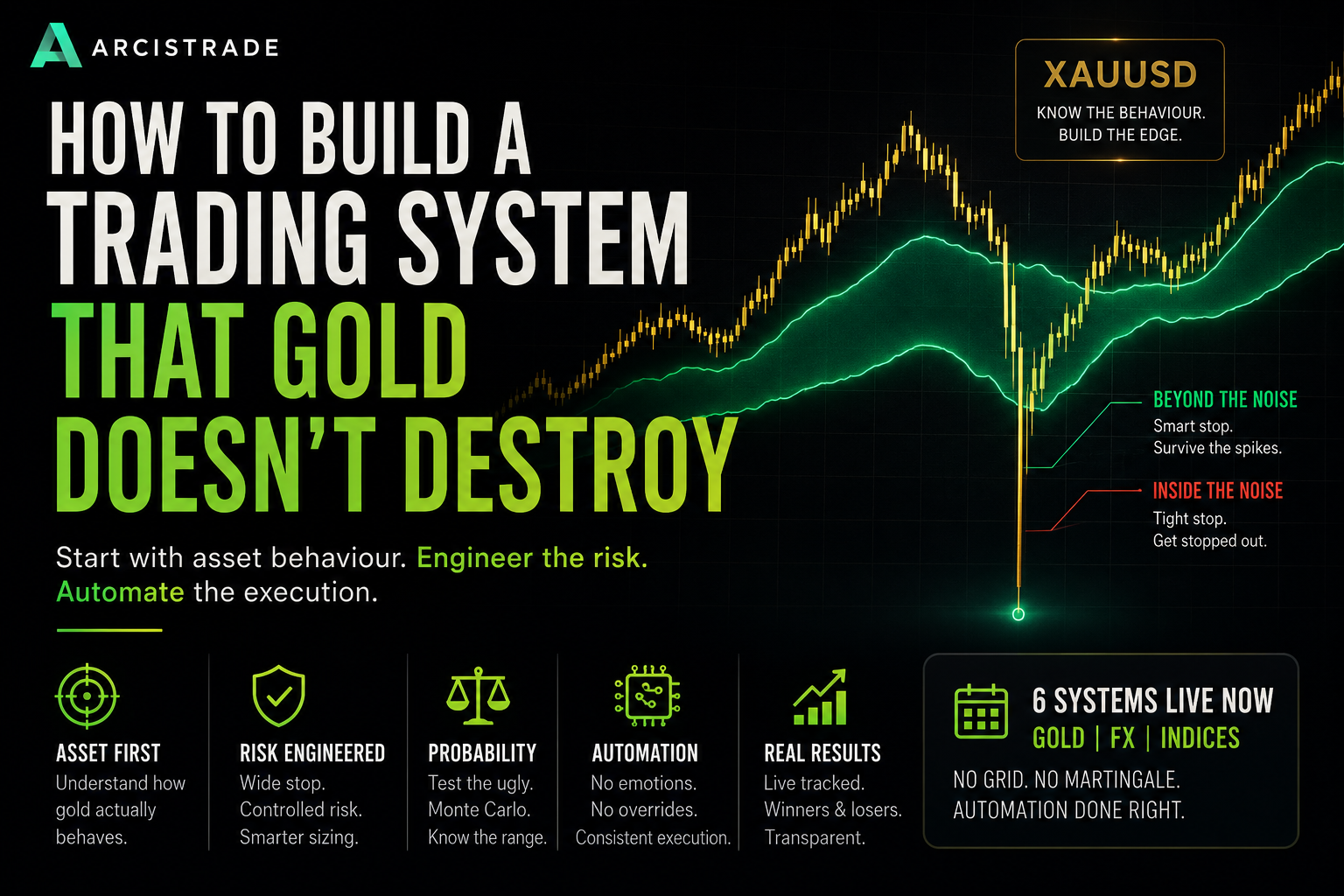
How To Build A Trading System That Gold Doesn't Destroy
A trading system can win 91% of its trades and still be completely misunderstood. Here’s why professional trading system development starts with the behaviour of the asset — not indicators — using gold, risk, probability and a live tracked account as the example.
and still be completely misunderstood by the person trading it.
Sounds ridiculous.
But here's how it happens.
You watch trade after trade close in profit.
10 winners.
20 winners.
Maybe 30.
And eventually a dangerous thought appears:
“If this thing wins this often... why aren't we trading bigger?”
Then the loss arrives.
And suddenly everybody wants to know what went wrong.
Nothing went wrong.
The system did exactly what it was designed to do.
The problem was that nobody understood why it was designed that way in the first place.
And that gets us to one of the biggest mistakes in trading system development.
Most traders start with a strategy.
I start with the asset.
Because if you don't understand how the thing you're trading actually behaves, every rule you build afterwards is sitting on sand.
And gold is probably the best example on Earth.
Trading system development usually starts in the wrong place
Here's how a huge amount of retail trading system development happens.
Open TradingView.
Throw an indicator on the chart.
Add another one.
Change the settings.
Run a backtest.
Ugly?
Change it again.
Better?
Keep going.
Eventually...
Bingo.
Beautiful equity curve.
Great win rate.
Low drawdown.
You feel like you've discovered fire.
Then you put it into the real market and gold kicks it straight in the teeth.
Why?
Because you designed the strategy around an indicator.
Not around gold.
That's backwards.
Before I care about an RSI level, moving average, volatility filter or entry pattern, I want to know:
How does this asset move?
How far does it normally move?
How quickly?
When does it become violent?
How deep are the false moves?
What happens before a real move?
How long do those moves normally last?
Because the answers dictate everything else.
The stop.
The size.
The entry.
The exit.
The holding period.
The sessions.
Even whether the bloody strategy should exist at all.
Gold is not EURUSD with a yellow colour scheme
Different markets have different personalities.
EURUSD can grind.
Indices have their own session behaviour and opening volatility.
Gold?
Gold has no problem punching $10 in one direction...
taking out half the stops on the screen...
then turning around as though nothing happened.
If you've traded XAUUSD long enough, you've probably experienced this:
You get the direction right.
Your entry isn't terrible.
Price spikes against you.
Stopped.
Then five minutes later...
price is exactly where you expected it to go.
And now you're sitting there wondering whether your broker personally hunted your 0.05 lot position.
They didn't.
You put your stop somewhere gold regularly visits.
That's a design problem.
Not a conspiracy.
And once you understand that, an apparently strange system design suddenly makes sense.
Why would a trading system deliberately use a wide stop?
Because tight stops and volatile markets are not automatically good friends.
Retail traders love tight stops because they make the maths look sexy.
Tiny risk distance.
Big reward-to-risk multiple.
Beautiful screenshots.
The problem is that a stop isn't supposed to look attractive.
It's supposed to sit somewhere that invalidates the trade.
If the normal movement of the asset repeatedly reaches your stop before continuing in the expected direction, your stop is sitting inside the noise.
Gold makes this brutally obvious.
So one approach is to move the stop farther away.
And immediately somebody says:
“But that's more risk!”
No.
Not necessarily.
And understanding this distinction changes everything.
Stop distance and account risk are not the same thing
Suppose you've got a $10,000 trading account.
You decide:
Maximum risk per trade = 0.5%.
That's $50.
Now imagine your strategy needs a wider stop because that's what the behaviour of gold requires.
You don't suddenly say:
“Ah well, guess we're risking $300 now.”
You reduce the position size.
Wide stop.
Smaller position.
Same $50 risk.
That's how percentage risk is supposed to work.
The market determines where the stop belongs.
Your account determines how large the position can be.
Retail traders often do the exact opposite.
They decide:
“I trade 0.1 lots.”
Then they stick that same position onto completely different trades with completely different stop distances.
That's not risk management.
That's habit.
And with gold, habit gets expensive very quickly.
Here's how a good system gets turned into a disaster
This is the part I see traders get wrong constantly.
Imagine a system has been performing extremely well.
The trader sees a very high win rate.
Confidence starts rising.
But not the good kind.
The dangerous kind.
“This thing barely loses.”
Which quickly becomes:
“I could make a lot more if I increased the size.”
So let's compare two people trading exactly the same system.
Same account.
Same signal.
Same entry.
Same stop.
Trader A
$10,000 account.
Risks 0.5%.
Worst case on the trade:
-$50
Two consecutive losses:
-$100
Annoying.
Not remotely fatal.
Trader B
Same account.
But he decides the system has been winning so often that percentage risk is “holding him back.”
He fixes the position at 0.1 lots.
Now suppose the stop equates to approximately $300 of exposure.
One loss:
-$300
Two losses:
-$600
Same system.
Same market.
Same trades.
But Trader A has had a mildly irritating afternoon.
Trader B is now questioning his life choices.
And what happens next?
You already know.
He switches the system off.
Changes the settings.
Complains that it stopped working.
Maybe starts hunting for another EA.
But the system didn't suddenly change.
He changed the risk.
The high win-rate trap
A 91% win rate sounds amazing.
It should also make you ask questions.
Because there are two very different ways a trading system can manufacture a high win rate.
Method one: hide the losses
This is where you often find:
adding to losing positions
escalating lot sizes
holding large unrealised losses
impressive balance curves hiding horrible equity curves
Those systems can look incredible.
Right up until the day they don't.
So if you're looking at any high win-rate automated trading system, don't stare at the headline number.
Ask:
Does position size increase after losses?
Does it keep adding to the same losing trade?
How many positions can be open simultaneously?
What does the equity curve look like?
That tells you far more than “91% win rate.”
Method two: design the loss distribution deliberately
Another structure is completely different.
Avoid getting clipped by ordinary market noise.
Take profits relatively quickly.
Accept that the smaller number of losing trades may be larger than the average winner.
That produces a completely different distribution.
Lots of smaller winners.
Occasional larger loss.
Is that automatically better?
No.
There's no magic configuration.
It is simply a trade-off.
And professional system development is largely about deciding which trade-offs you are prepared to accept.
There is no free lunch hiding in the win rate
This is one of the biggest lessons I've learned in nearly two decades around markets.
Every trading system pays somewhere.
High win rate?
Look at the average loss.
Huge average winner?
Expect more losing trades.
Tiny drawdown?
Check the sample size and market conditions.
Incredible backtest?
Look for curve fitting.
There is always a bill.
Your job isn't to find a strategy that never receives one.
Your job is to understand what the bill normally looks like before it arrives.
That's where probability enters the picture.
The losing streak nobody expects
Let's say your backtest contains a thousand trades.
You've had losing streaks before.
Maybe two.
Maybe three.
Then you start trading live.
Loss.
Loss.
Loss.
Loss.
And suddenly your brain starts screaming:
BROKEN.
But has anything statistically unusual actually happened?
You don't know.
Unless you've tested it.
This is where Monte Carlo simulation becomes incredibly useful.
Instead of looking at the historical trades in the exact order they happened, you reshuffle their sequence thousands of times.
Same underlying trades.
Different order.
Now you can ask:
What might the ugly version have looked like?
How long could the losing streak have been?
How deep could the drawdown reasonably have gone?
How lucky was the particular sequence shown in the original backtest?
That's information you can actually use.
Because once you know a six-loss streak is perfectly plausible...
three losses don't feel like the apocalypse.
They're just three losses.
That's mathematical confidence.
Not positive thinking.
Not staring into a mirror telling yourself you're a disciplined trader.
Knowing the numbers.
Long winning streaks create their own problem
Losing streaks aren't the only thing that mess with traders.
Winning streaks do it too.
Arguably worse.
You win.
Then win again.
Then again.
Your balance grows.
If you're using percentage risk, your position size gradually grows with it.
Then after a long streak...
the inevitable losing trade eventually arrives.
And because the account has grown, you're potentially carrying one of the largest positions you've carried during the entire run.
That's why one risk-management idea I've used is reducing position size after an extended winning sequence.
Not because I suddenly know the next trade will lose.
I don't.
The market doesn't care how many trades you've just won.
The idea is simply:
protect some of what the streak just built.
Give up a little potential upside at the very end of an unusually strong sequence...
in exchange for reducing the impact when a losing trade eventually appears.
Again:
Not prediction.
Risk engineering.
Huge difference.
Small gold accounts have another problem nobody talks about
Here's where theory crashes into reality.
You can say:
“I'll only risk 0.25% per trade.”
Great.
Until the minimum trade size already risks more than that.
Gold CFDs commonly have a minimum position size.
You cannot keep shrinking forever.
Eventually you hit the floor.
And when you do, the broker's minimum lot size begins determining the percentage risk instead of your risk model.
Consider the exact same $30 loss.
On a $50,000 account:
Barely noticeable.
On $2,000:
Meaningful.
On $1,000:
Potentially painful.
Nothing about the strategy changed.
The percentage impact did.
Which means the same perfectly normal losing run can look completely different depending on account size.
This is why small trading accounts often appear incredibly volatile.
It's not always because the strategy itself has suddenly become more volatile.
The account simply doesn't have enough sizing resolution.
This is visible on a real account
There's a TitanImpulse account running live and independently tracked on Myfxbook.
It started with €1,500 and trades gold using the smallest practical position sizing available.
You can see the account here:
https://www.myfxbook.com/members/AlgoVault/titanimpulse-ai/
Don't just look at the return.
Look at the ugly bits.
There's a drawdown that looks horrible on the chart.
Then look at what happens afterwards.
The losses were taken.
Nothing was averaged endlessly into the ground.
There wasn't a giant hidden basket waiting for price to rescue it.
So once the losing sequence ended...
the account could begin recovering immediately.
That's one of the things I want people to understand about real automated trading.
Automation isn't about creating a machine that never loses.
That machine doesn't exist.
The value comes from building rules that understand the market they're operating in...
defining the risk before the trade...
and executing consistently when the uncomfortable periods inevitably arrive.
Will a profitable trading system work forever?
No.
And anyone promising that should make you extremely suspicious.
Every trading strategy exploits some type of behaviour.
Trend.
Mean reversion.
Volatility expansion.
Momentum.
Session behaviour.
Liquidity.
Whatever it happens to be.
If the behaviour changes enough, the edge can weaken.
TitanImpulse is designed around behaviour in gold.
If the characteristics it exploits disappear, performance can deteriorate.
That's not a failure of systematic trading.
That's exactly why systematic traders should monitor systems.
And it's one of the strongest arguments for not betting everything on one strategy.
One system.
One market.
One behaviour.
One point of failure.
I'd much rather have several strategies exploiting different behaviours and continuously compare their real performance against what testing told me to expect.
That's portfolio thinking.
So how should you actually build a trading system?
Not like this:
Indicator → settings → backtest → pray.
Start here:
1. Study the asset
Understand its volatility, sessions, noise, typical excursions and abnormal behaviour.
2. Find behaviour worth exploiting
Not an indicator pattern that happens to test nicely.
An observable market behaviour.
3. Build rules around that behaviour
Entry.
Exit.
Stop.
Holding period.
Filters.
4. Define risk independently from the setup
Know how much the account can lose before you calculate position size.
5. Stress-test the distribution
Look at losing streaks.
Drawdown.
Sequence risk.
Monte Carlo outcomes.
6. Forward test it
Because the market doesn't care how beautiful your backtest was.
7. Monitor whether reality still resembles the assumptions
Systems aren't religious beliefs.
If the underlying behaviour genuinely changes, the system should eventually be changed or retired.
But that decision should come from data.
Not because you had a rough Tuesday.
The real lesson
A trading system isn't a clever entry.
It's an entire risk machine built around the behaviour of an asset.
That's why two traders can take exactly the same signals...
and one survives while the other blows up.
That's why a wide stop can actually be conservative.
That's why a high win rate can be either genuinely interesting or catastrophically dangerous.
That's why the same gold trade can be trivial on one account and terrifying on another.
And that's why the numbers matter more than the story you tell yourself after the last trade.
Study the asset.
Build around its behaviour.
Know the distribution.
Control the risk.
Then automate the execution.
That's trading system development done in the right order.
Want to see what that looks like in practice?
ArcisTrade currently runs multiple automated systems across gold, FX and indices.
Every trade is tracked — winners and losers.
No martingale.
No grid.
No pretending losing trades don't exist.
You can watch the systems operate for 14 days using virtual funds before deciding whether automated trading is for you.
Common questions
What is the most important part of trading system development?
Understanding how the specific asset behaves before designing the trading rules. Volatility, typical noise, trading sessions, stop placement and holding time should come from the characteristics of the instrument rather than being copied from another market.
Why can wider stops make sense when trading gold?
A stop placed inside normal gold volatility can repeatedly close otherwise valid trades. A wider stop can sit beyond ordinary price noise, provided position size is reduced so total account risk remains controlled.
Does a wider stop automatically mean more risk?
No. Under percentage-based position sizing, account risk is selected first. A wider stop therefore requires a smaller position. Stop distance and account risk are separate variables.
Is a 91% win rate proof that an EA uses martingale?
No, although a very high win rate deserves investigation. Check whether the system adds to losing positions, increases lot size after losses, holds large baskets of correlated positions, or hides unrealised drawdown.
What is Monte Carlo simulation in trading?
Monte Carlo analysis rearranges a strategy's historical trade sequence thousands of times to estimate the range of drawdowns and losing streaks that could reasonably have occurred.
Why is gold harder to risk properly on a small trading account?
Minimum position sizes place a floor underneath how small a trade can become. On sufficiently small balances, that minimum trade may represent a larger percentage of the account than the trader would ideally choose to risk.
Does automated trading eliminate losing trades?
No. Proper automation executes predefined trading and risk rules consistently. Its advantage is disciplined execution, not eliminating the normal losses inherent in probabilistic trading.