Why One Trading Strategy Isn't Enough (And Why AI Is About To Make It Worse)
Every trader finds something that works, then bets the whole year on it. Here's why running one strategy is the real risk, and what AI is about to do to the gap.
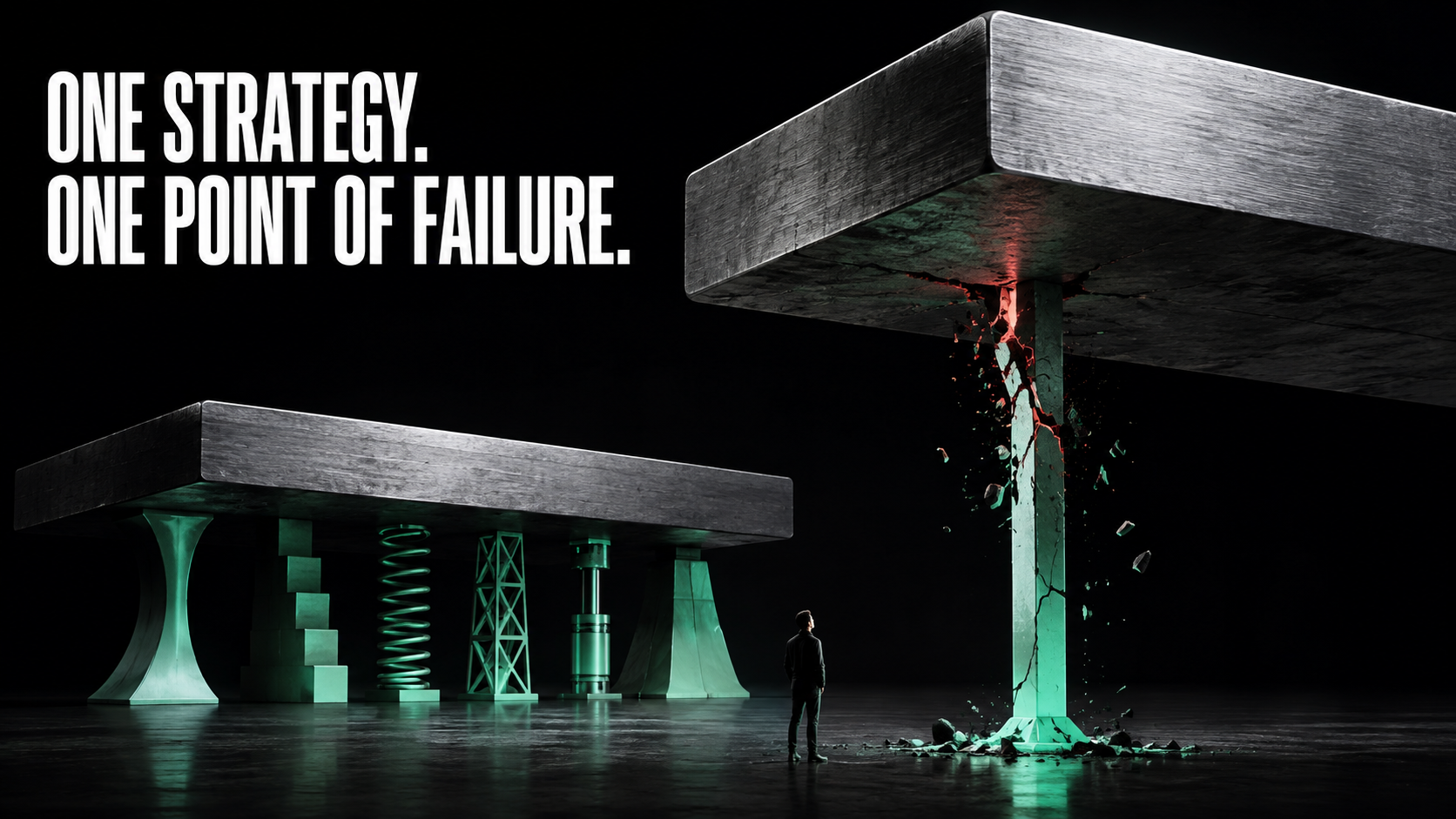
A setup. A pattern. A market they read better than most.
They spend years sharpening it.
And then they bet their entire year on it.
Not deliberately. Nobody decides to do that.
It just happens, because one strategy is all a person has time to run.
That's the trap, and almost nobody sees it as a trap.
They see it as focus.
What happens when your one trading strategy has a bad month
Every strategy has bad stretches. Every single one.
A trend system dies in a range. A range system gets destroyed by a trend.
A breakout system spends six weeks getting picked off by false starts.
None of that means the strategy is broken.
It means the market isn't currently paying for that behaviour.
Now here's the problem with running one of them.
When it goes cold, there's nothing else.
No second engine. No cushion. Nothing carrying you while it recovers.
Just you, a drawdown, and a lot of time to think about it.
And that's when the damage happens.
Because you don't sit there patiently. Nobody does.
You start tinkering. You size up to catch back up.
Or you bin it entirely and go looking for a better strategy — which becomes your new single point of failure by Thursday.
The trading strategy rarely kills the account. The reaction to the drawdown does.
Why running multiple trading strategies changes the maths
Here's what a multi strategy approach actually does, and it's not what most people assume.
It doesn't make you more money in a good month. It usually makes you slightly less.
What it does is change what a bad month looks like.
One strategy having a shocker inside a portfolio of six is a rounding error.
The same strategy having the same shocker on its own is your whole quarter.
Same trades. Same losses. Completely different outcome.
And there's a second effect that matters more.
It stops you interfering.
When one system is down and four others are up, you don't panic. There's nothing to panic about.
You never reach the emotional state where the stupid decisions get made.
That's worth more than the diversification itself.
But six copies of the same idea isn't diversification
This is where most people get it wrong, and it's worth being precise.
Running six breakout systems on six currency pairs is not a multi strategy portfolio.
It's one idea wearing six coats.
When breakouts stop working, all six stop working on the same Tuesday.
You've multiplied your exposure and called it safety.
Real separation means the systems behave differently:
- Different logic — trend, mean reversion, momentum, structure
- Different markets — gold behaves nothing like an index
- Different timeframes — a swing system and an intraday system don't share a bad week
- Different hold times — one in for minutes, one in for days
Here's a useful example of what genuinely different looks like.
One system might win 90% of its trades with small winners and rare, larger losers.
Another might win 32% — wrong two times out of three — but with winners four to eight times the size of its losers.
Both make money. Neither has a bad week at the same time as the other.
That's diversification. Not six versions of the same bet.
Why manual traders can't do this
Here's the honest problem, and it isn't about skill.
Say you've got three genuinely different edges. Gold in the Asian session.
An index at the New York open. A swing setup on FX.
All three work.
You can trade roughly one of them.
Because you have one set of eyes, one screen, and you need to sleep sometime.
So you pick the one that fits your life, and the other two sit there unused.
That's not a discipline problem or a knowledge problem.
It's a physics problem.
And it gets worse. Because even running one strategy properly means being present when it fires, staying sharp for hours while nothing happens, and executing identically on your worst day as your best.
Nobody does that. Commercial pilots are trained for sustained attention and even they hand the long boring stretch to autopilot.
You've had no such training and there's money on the line.
The ceiling on a manual trader isn't their edge.
It's their body.
What automation actually solves
Automation isn't magic and it doesn't create an edge. Feed it a losing strategy and it will lose faster and more politely than you ever managed.
What it removes is the ceiling.
Simultaneity. Six strategies, six markets, six sessions, at the same time. A human can't. A machine doesn't notice the difference.
Consistency. Trade 400 is executed exactly like trade 1. No fatigue, no boredom, no view about the last loss.
Presence. It's awake when gold moves at 3am and you aren't.
Emotional flatness. It takes the loss, logs it, moves on.
That's it. No revenge trade, no widened stop, no "just this once."
That last one is the real prize.
Most traders don't lose because their strategy is bad. They lose because of what they do to it in the middle of a drawdown.
A system doesn't do anything to it.
Will AI replace retail traders?
Not replace. Something more uncomfortable than that.
It widens the gap.
Here's the honest version, without the hype.
AI doesn't invent an edge. It can't read a chart and discover something profound that nobody's noticed.
What it does brilliantly is scale, test and execute an edge that already exists.
Which means anyone who has a tested edge gets a multiplier.
And anyone who doesn't gets an expensive way to lose faster.
The uncomfortable part is what that does to the market.
A larger share of intraday volume is already automated.
Order flow that used to be slow enough for a discretionary trader to read now moves in milliseconds. Moves get faster, cleaner and more crowded.
The intraday discretionary trader — the one clicking buttons on a five-minute chart — is competing directly with that. Not with other humans.
That's not a fair fight and it's getting less fair.
Longer timeframes are more forgiving. Structural moves still play out over days and weeks, and judgement still matters there.
But the middle ground is disappearing.
What this means if you're trading manually right now
Not "give up." That's not the lesson.
The lesson is about where your effort goes.
If your edge is real, your bottleneck isn't finding a better one. It's that you can only run it a fraction of the time and you can't run anything alongside it.
More screen time doesn't fix that. Screen time is the limit.
Three things worth doing regardless of what you decide about automation:
Know your numbers. Average winner, average loser, longest losing streak, worst drawdown.
Without those you can't tell a broken system from a bad month, and they feel identical from the inside.
Write your stop rule before you need it. Decisions made during a drawdown are made by the worst version of you.
Stop judging systems on win rate. A 32% system with big winners beats a 90% system with hidden losses every time.
What we built and why
I traded by hand for most of twenty years. Desks, gold, FX, indices.
I ended up with several things that worked and the ability to run about one of them.
That's the whole reason ARCIS Trade exists.
Six systems running simultaneously across gold, FX and indices.
Different logic, different timeframes, different hold times. Some stable, some higher risk. You choose which run and how much goes to each.
Three rules on every system, non-negotiable:
No martingale, no grid. Nothing ever adds to a losing position.
One trade at a time. Each position stands or falls alone.
Risk first. Stop placed before the trade, off market structure, never moved because the trade got uncomfortable.
And every trade is visible, open to close — the losers sat next to the winners, and the systems still in forward testing shown alongside the live ones.
Because a portfolio you can only see the good half of isn't a portfolio.
It's a marketing page.
Watch it run for 14 days. Free, no card, nothing to install.
[Start your 14 days →]
P.S. If you're running one strategy right now, do this. Work out what happens to your year if it goes flat for three months. Not blows up — just flat. That's the more likely scenario and almost nobody plans for it.
Common questions
How many trading strategies should you run at once?
More than one, and enough that no single strategy dominates the outcome. What matters more than the number is that they behave differently — six versions of the same idea is not diversification.
Is multi strategy trading better than one strategy?
It usually produces slightly lower returns in strong months and considerably smaller drawdowns in bad ones. The main benefit is that it stops you interfering during a losing stretch.
Can you run multiple trading strategies manually?
Rarely more than one properly. Different strategies fire in different markets and sessions, and a manual trader can only be present for a fraction of them.
Will AI replace retail traders?
It is unlikely to replace them outright, but it widens the gap between traders with a tested edge and those without. AI scales an existing edge — it does not create one.
Does automated trading remove emotion from trading?
It removes emotion from execution, which is where most damage happens. It does not remove your emotion about the results, which is why a written stop rule matters.