AI Trading Agents Are Everywhere. Almost None Of Them Work
AI trading agents are everywhere right now. Here's what they can genuinely do, what they can't, and the one question that decides whether any of them make money.
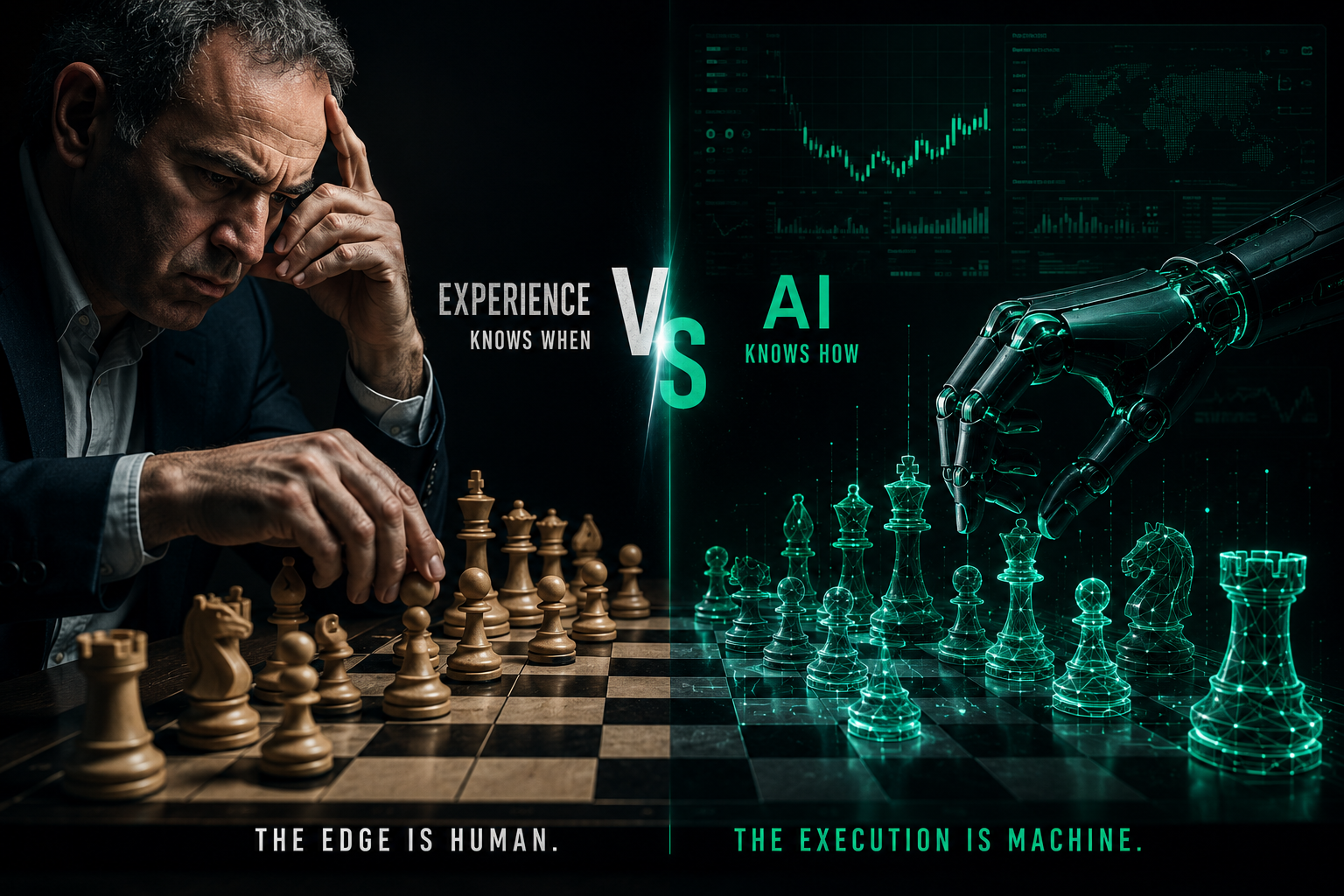
In 1997 a computer beat the world chess champion.
Deep Blue. Garry Kasparov. Six games.
Everyone said chess was finished.
Obituaries were written. Actual obituaries. For a board game.
It wasn't finished.
What happened next was much stranger.
Within a few years the best chess on earth wasn't played by computers.
It wasn't played by humans either.
It was played by humans working with computers.
They called them centaurs, which is a lot cooler than what they actually were — blokes with laptops.
And for a while, a decent amateur with a decent laptop could beat a grandmaster.
He could also beat a supercomputer.
Not because he was brilliant. He wasn't.
Because he knew when to trust the machine and when to tell it to wise up.
Hold that thought.
Because right now your feed is full of AI trading agents.
New bot. New agent. New plugin. Every single day.
Half of them announced by a lad in a hired Lamborghini.
And everyone's asking the same question.
Can AI actually trade?
Here's the honest answer.
It depends entirely on what you feed it
AI has no opinions about markets.
No view on gold. None on the dollar.
It doesn't know what a good trade looks like.
It knows what you told it a good trade looks like.
That's the whole thing. That's the entire mechanism.
Feed it something that works and it'll run it forever without complaining.
Feed it something that loses and it'll lose faster than you ever managed.
Politely. Consistently. Around the clock. Even on Christmas Day.
AI is a yes man.
Hand it rubbish, it hands you back rubbish with better graphics.
So who is teaching these AI trading agents?
This is the bit that should worry you.
Most AI trading agents are being built by retail traders.
Not desk traders. Not quants.
Retail traders, automating exactly how they already trade.
And the numbers on retail trading aren't a secret.
Brokers publish them because regulators make them.
Somewhere between 70% and 80% of retail accounts lose money.
So we've now got machines learning to trade from a group that mostly loses.
Faster. At scale. Twenty-four hours a day.
Genius.
The machine isn't the problem here.
The teacher is.
What AI is genuinely good at
Right, let's be fair to it.
What AI is brilliant at:
- Watching many markets at once
- Executing the same rule forever
- Working overnight without getting tired
- Not caring how it feels about a loss
- Testing thousands of variations
Every one of those is something humans are terrible at.
Not because we're stupid.
Because we get tired, bored, frightened and greedy.
Usually in that order. Usually by Wednesday.
What AI is useless at:
- Knowing why a market moved
- Handling something it's never seen before
- Explaining its own reasoning
- Adapting to a real regime change
- Telling you when it's wrong
Every one of those comes from experience.
That's the centaur again.
The machine does the first list.
You do the second one.
The question that actually decides it
There's one question that separates automation that works from automation that doesn't.
It's not "is it AI?"
It's not "what's the win rate?"
It's this.
Did the strategy work before it was automated?
If it did, automation removes your worst days from it.
If it didn't, automation just industrialises the losing.
Nobody puts that on a sales page.
Mostly because they've never traded the thing by hand at all.
They built it, backtested it, and stuck it up for sale by Thursday.
Why the pretty equity curves are the dangerous ones
Here's something worth knowing.
Want an equity curve with no losing days?
Easy. Takes about a fortnight to build.
You simply never close a losing trade.
Open a position. It goes against you. Open a bigger one.
Average down until price comes back to say sorry.
Every trade closes green. The line goes up like a staircase.
Beautiful. Frameable.
That's martingale, and it's most of the marketplace.
It works brilliantly right up until it doesn't.
And when it doesn't, it doesn't take a loss.
It takes the account. The whole thing. In an afternoon.
So a 95% win rate with no drawdown isn't a good sign.
That's not a track record. That's a countdown.
What honest automated trading actually looks like
Real systems lose. Constantly. It's the job.
One of ours wins about half its trades.
Half. You could get that flipping a coin and you'd have more fun doing it.
It still finishes most weeks up, because the winners are bigger than the losers.
That's not a flaw in the system. That is the system.
Another one went live and lost both of its first two trades.
Both. On its debut. Very embarrassing for everyone involved.
It's still on the results page, sulking.
Here's the checklist for any AI trading agent you're offered.
- Can you see every trade, open to close, as it happens?
- Are the losers visible, or only the winners?
- Does it ever add to a losing position?
- Is the stop set before the trade, or negotiated afterwards?
- Can you see a bad month, not just a good week?
- Does the seller show the systems still being tested?
If most of those are a no, you're not looking at automation.
You're looking at marketing with a chart on it.
So where does that leave you?
Back to the centaurs.
The best automation isn't AI replacing the trader.
It's a tested edge, built by someone who traded it by hand first, running on something that doesn't get bored at 2pm.
The human decides what a good trade is.
The machine takes every one of them at 3am, in a market you're not watching, without moving the stop because it's got a feeling about it.
The AI isn't the edge.
The AI is what lets the edge run while you're asleep.
The two roads
So you've got two options.
Keep scrolling past AI agents built by people who won't show you a single losing trade.
Or go and watch one run in the open and make your own mind up.
Fourteen days. Free. No card, nothing to install.
Every trade visible, open to close. Winners and losers both.
The ones still in testing are on there too, warts and all.
[Watch it trade for 14 days →]
P.S. Whatever you're running right now, do one thing tonight. Find its worst losing streak. Not the profit — the losses. If you genuinely can't find any, you haven't found a system. You've found a marketing page with a countdown attached, and you don't know what number it's on.